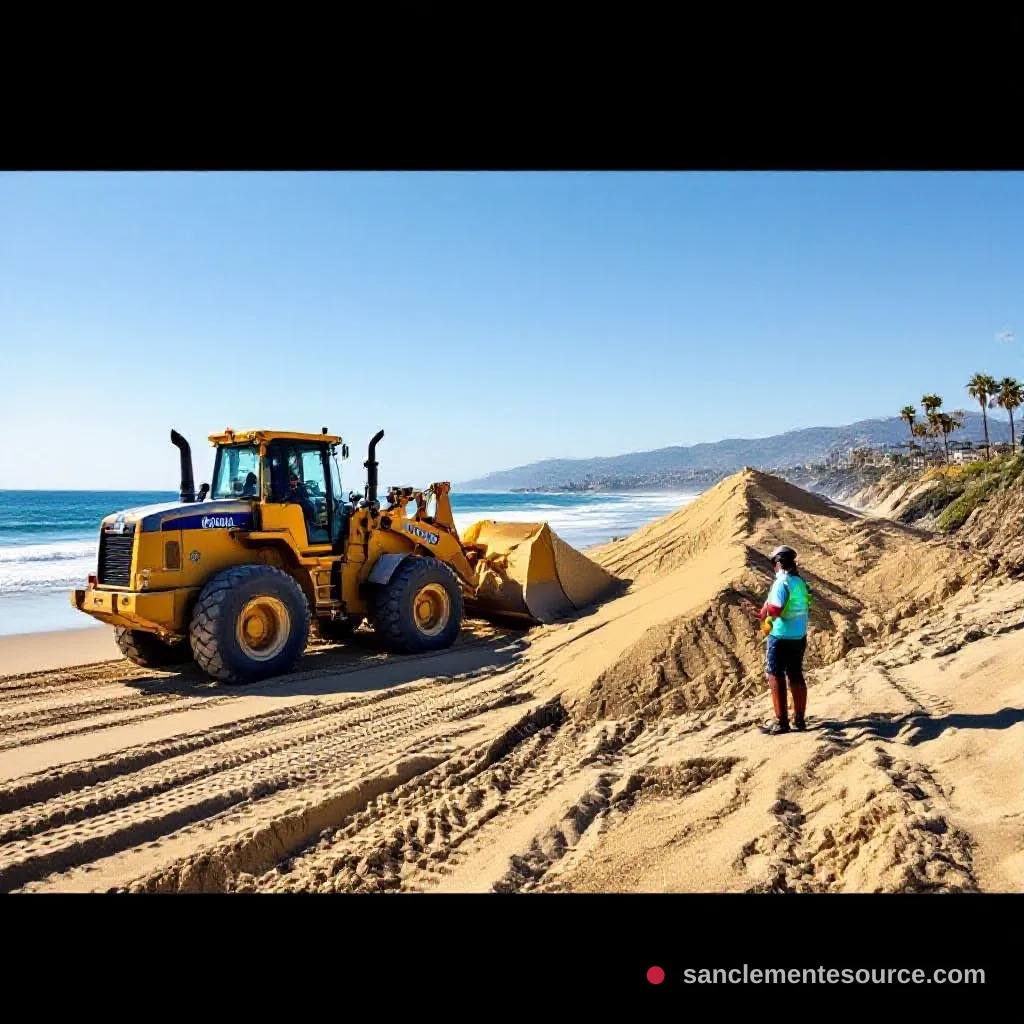
The San Clemente City Council unanimously voted at its Tuesday, June 4 meeting to approve actions that would bring approximately 30,000 cubic yards of sand to North Beach. To fund the transportation costs, the council allocated over $800,000 from the city's sand account and over $500,000 previously marked for the Sand Compatibility and Opportunistic Use Program (SCOUP), totaling $1.38 million for the project. This decision effectively suspends the SCOUP program for an estimated two years.
City Manager Andy Hall informed the council that this opportunity arose suddenly on the previous night and required a rapid decision. Hall stated that they needed "to have a decision for tonight so that we can pull the trigger, literally tomorrow, on an RFP (Request for Proposal) so that we can get this going." According to Hall, Orange County Parks had previously identified free sand that could be made available to San Clemente, with this possibility recently becoming a reality.
Placement of the sand could begin as early as late June and is expected to last about 70 days. Construction activities are planned for Mondays through Thursdays, involving 40 trucks daily. The California Coastal Commission (CCC) will not permit activity on weekends, Hall explained. All the sand will be placed above the mean high tide line because the project is proceeding under a waiver, leaving no time to secure a permit from the California State Lands Commission for placement below that line, Hall said. City officials had surveyed North Beach and determined the area was large enough to accommodate the sand.
Hall also discussed the broader context of sand replenishment efforts along San Clemente's coastline. He stated that the CCC recognizes the urgent need to get sand on the city's beaches as quickly as possible, given ongoing actions by the Orange County Transportation Authority (OCTA) and the city. The CCC is willing to consider waivers and allow the city to bypass certain bureaucratic environmental processes to facilitate sand placement.
While San Clemente is responsible for the $1.38 million payment, city officials are actively seeking assistance. Hall indicated that the city is asking the CCC to help cover the cost, framing it as mitigation for OCTA’s project at Cyprus Shores. The city manager noted that the CCC acknowledges San Clemente's tight budget and the financial burden this project presents. Hall expressed hope that these efforts would be successful.
Hall also mentioned a potential opportunity for an additional 40,000 to 45,000 cubic yards of sand from Huntington State Beach to be placed at Calafia Beach. City officials are hopeful that OCTA would include this project under its mitigation obligations. If that does not materialize, the city plans to continue searching for alternative funding options.
Councilmembers acknowledged the urgency of securing sand for San Clemente's beaches, though some expressed concerns about the project's broader implications. Mayor Victor Cabral supported the initiative, arguing that using the funds now was a better option compared to continuing the SCOUP pursuit, which might leave the city without money for actual sand delivery. Cabral also speculated that the SCOUP delay might not last the full two years.
Councilmember Steve Knoblock raised concerns about halting an active program like SCOUP. He questioned whether the city could instead use rollover funding from its current or future unassigned fund balance. Hall reassured Knoblock that the city would seek to shift available funds in the future to re-engage SCOUP, recognizing that the current method of funding is unsustainable.
Mayor Pro Tem Mark Enmeier praised Hall's efforts but emphasized the unsustainable nature of the city's current approach to sand replenishment and the need for more funding sources. Enmeier conveyed a message to the community that eventually, unless the community actively supports solutions, the city would face depleted options for such projects.