
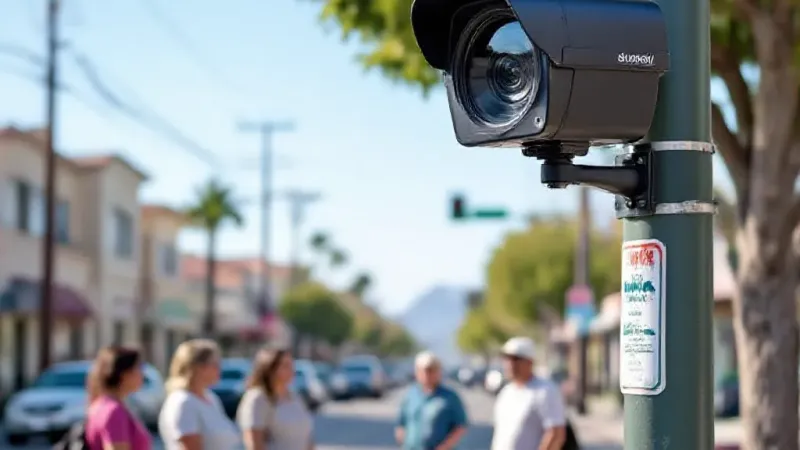
Fullerton officials are preparing to conduct an expanded review of the city's policy governing its automated license plate reader (ALPR) cameras, known as Flock cameras, following increasing privacy concerns from residents and calls for stricter oversight. The upcoming discussion by the City Council comes after a public presentation last week on how the Fullerton Police Department utilizes the nearly 20 cameras installed across the city.
Fullerton residents have raised specific worries that the images and data captured by these cameras could be leaked or potentially used by federal agents for immigration enforcement. Councilmember Ahmad Zahra has called for the upcoming, in-depth discussion, citing instances of data leaks in other cities and noting that some municipalities have suspended their contracts for similar camera systems. Zahra stated at the Sept. 15 meeting, calling for systems that are "credible, vetted, and constantly reviewed" with clear public policies. Councilmember Shana Charles also supported the discussion, expressing concerns about residents' civil liberties. Resident Deborah Langenbacher acknowledged the potential utility of the cameras for law enforcement but voiced apprehension about "excessive surveillance" on law-abiding citizens.
Fullerton Police Chief Jon Radus maintains that the city's Flock cameras are legally positioned on public roads where, he stated at the Sept. 15 meeting, "there is no expectation of privacy," a stance he noted has been established by courts. Chief Radus assured the community that the Fullerton Police Department has policies in place to prevent misuse of the data and does not share collected information with federal immigration agents, citing Senate Bill 54. Furthermore, the department is restricted from sharing data with agencies outside of California.
According to Chief Radus, the Fullerton Police Department controls the flow of collected data, which is erased after 30 days unless preserved as evidence. He clarified that Flock, the camera provider, does not sell customer data and can only share information with parties authorized by the city. Personal use of the system is strictly prohibited for authorized users, who must provide their name, reason for the search, and a case number, with each search being permanently logged for accountability.
Since their installation in 2021, Fullerton's Flock cameras have cost the city $236,000 for equipment, subscriptions, and maintenance. Police officials credit the cameras with helping to recover 274 stolen vehicles and locate 18 missing persons. The system is accessed by 135 authorized police officers who complete required training, and detectives reportedly use Flock for investigative leads in "virtually every investigation."
The cameras capture still images of license plates and vehicles, comparing them against a "hotlist" of stolen or flagged vehicles to generate investigative leads. Chief Radus explained that the system employs artificial intelligence to assist in finding described vehicles within specific locations and timeframes. However, when questioned by Councilmember Zahra about the specifics of how AI processes data, Chief Radus acknowledged, "I am not an expert on how Flock works." He clarified that the cameras do not record video, utilize facial recognition or biometrics, or store personal identifiers like names, birth dates, or social security numbers. Information from the DMV is only accessed if a vehicle is already on a hotlist. The system is also not used for continuous tracking of individuals, crime prediction, or the enforcement of immigration or traffic laws.
Fullerton's camera system can be utilized in two ways: real-time alerts or post-incident investigations. In real-time scenarios, officers receive notifications about vehicles or license plates linked to a crime but must verify the information with other departmental databases before initiating a stop. For post-incident investigations, detectives can search for vehicles connected to reported crimes and track flagged vehicles' movements across other participating California jurisdictions and businesses. Flock's transparency webpage indicates the cameras have detected over a million unique vehicles and flagged approximately 5,100 vehicles in the last 30 days, with about 500 searches conducted on the system during the same period.
To ensure accountability, Chief Radus stated that department supervisors will now audit the system quarterly, a change from the previous annual schedule, reflecting his desire not "to find out that there’s a potential problem." The system itself is designed to automatically flag abnormal behavior, such as searches extending beyond the 30-day data retention period, repeated plate searches, broad or unusual queries, or searches involving personal or sensitive information. Flock also conducts its own audits of who accesses Fullerton's system. Mayor Fred Jung, however, remarked at the meeting that Councilmember Zahra was "soapboxing" and suggested he await the next meeting for answers, to which Zahra responded he was simply doing his job. While Fullerton has 19 Flock cameras, California State University, Fullerton, also operates 46 Axon cameras, which are described as similar systems.
The debate in Fullerton mirrors discussions in other Orange County cities. Santa Ana is slated to review its Flock camera contract next month due to resident concerns about privacy and federal agents' data access. Almost two months prior, Costa Mesa decided to retain its Flock contract despite resident objections and an incident where a Costa Mesa police officer misused the cameras to stalk individuals.