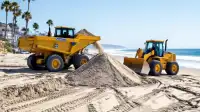
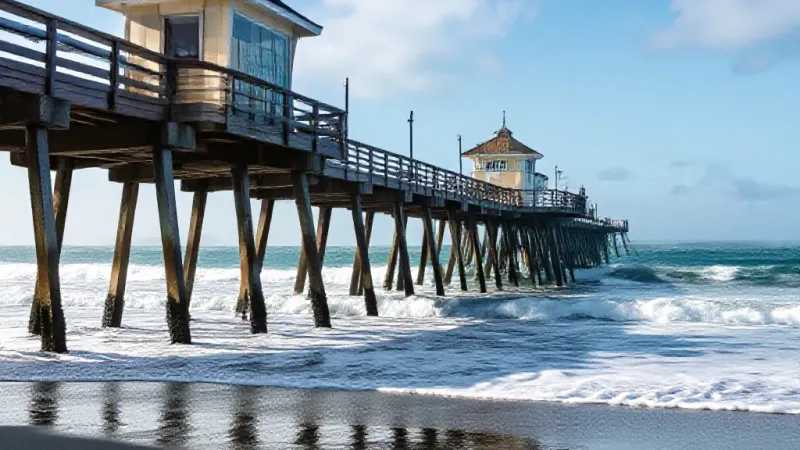
San Clemente’s beaches are significantly eroded, leading to questions from residents and concern from city officials ahead of a potential "super El Niño" this winter. The city's coastline, already battered by recent swells from Hurricane Marie, appears starkly different from neighboring cities like Newport Beach, which is expediting sand replacement. City officials acknowledged at a weekend informal gathering that the city has not adequately prioritized sand replenishment in past decades.
City Manager Andy Hall stated at a Saturday park gathering near the coast that San Clemente is now "paying the price" for not aggressively replenishing its beaches over prior decades. Hall described the situation as an "existential" threat, noting that the city had not been as proactive as it should have been. This erosion occurs while the OC Transportation Authority (OCTA) has protected the Pacific Surfliner rail line with rocks, which Hall indicated has severely reduced the city’s sand along the coast. Residents witness the daily shrinking of their beaches, with some paths now blocked as they lead only to rock.
Hall urged the OCTA on Saturday to advocate more vigorously for sand. He said he hoped they would push as hard for sand on the beach as they have for rocks on the revetment, adding that OCTA should be a strong voice for sand, preferring it over rock. San Clemente Councilman Victor Cabral, also speaking on Saturday, expressed a desire for OCTA to repair future damage caused by these rocks.
To address the funding gap for beach restoration, San Clemente voters will consider Measure M, a sales tax initiative, this November. Proposed by local resident Cameron Cosgrove, the measure would introduce an additional 1% sales tax for ten years. If approved by over 50% of voters, proceeds would be divided between sand purchasing and city fireproofing efforts. Cosgrove indicated at the Saturday event that San Clemente faces a sand deficit of two to four million cubic yards, which could expand the beach by approximately 100 feet. He estimated the cost to acquire four million cubic yards at $100 million, stressing that even with the sales tax, the city would need to aggressively pursue grants and other funds.
City Manager Hall clarified that San Clemente's budget is currently stable and healthy, but lacks the extra funds for projects not undertaken in the past, specifically beach restoration. Councilman Cabral noted the city has identified potential sand sources, but projects cannot advance without funds. He added that federal funding sources are being explored as a contingency if the tax measure fails. Cabral emphasized the urgency, stating that the crisis is happening in real time, with residents reporting water intrusion into their backyards during recent swells.
Following the recent swells, city leaders approved an emergency expenditure of $1 million to stabilize the coastline. The city is also slated to receive an additional $1 million from the state government, supported by State Sen. Tony Strickland.
In contrast, Newport Beach leaders acted swiftly after the recent swells, accelerating their standard sand replenishment schedule. They plan to place approximately 100,000 cubic yards of new sand along their beaches, sourced from the Santa Ana River. While Supervisor Katrina Foley initially mentioned 200,000 cubic yards, city spokesperson Georgia Rios clarified that permits allow for this amount, but only about 100,000 cubic yards are currently available. This project, expected to commence later this month, is projected to cost Newport Beach between $1 million and $1.5 million, according to Rios. Rios stated that while West Newport's sand replenishment typically occurs each winter, the work was expedited this year due to the anticipated El Niño storms to safeguard homes and the coastline. OC Public Works spokesperson Jamie Cargo noted that city staff, rather than county staff, would manage the sand movement this time, a task county staff had performed for the past nine years.
City Manager Hall observed on Saturday that cities like Newport Beach are in a better position because they established annual replenishment programs years ago, a practice San Clemente has not adopted. Hall said that San Clemente needs to get into that mode. He also attributed Newport Beach's financial capacity for sand to its development of malls and other tax-generating attractions, contrasting this with San Clemente's choice to remain a smaller beach town, which necessitates alternative fundraising strategies. Councilman Cabral affirmed the city's efforts to engage more local leaders, advocating for transportation dollars to be invested along the coastline rather than inland, aiming to shift spending priorities towards coastal needs.