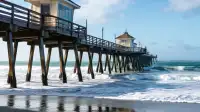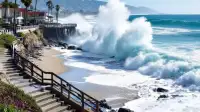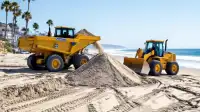

A San Clemente-based environmental group warned Tuesday that emergency seawalls are contributing to beach erosion nationwide, with most coastal states lacking adequate safeguards to prevent temporary barriers from becoming permanent. The Surfrider Foundation’s 2026 State of the Beach Report found that these emergency measures often become long-term fixtures, leading to significant beach loss and restricted public access.
The report specifically cited emergency construction along the railroad corridor in San Clemente. Here, roughly 27,000 tons of large rocks, known as riprap, have been placed along the coast under a series of emergency permits issued since 2021. According to Surfrider, these barriers have made a stretch of beach connecting the Trestles surfing area to the rest of San Clemente impassable, impacting access for surfers and beachgoers alike. The organization cautioned that while such projects might protect infrastructure in the short term, they contribute to long-term beach erosion and the permanent loss of public access.
Nationwide, the Surfrider Foundation evaluated 30 coastal and Great Lakes states, finding that 27 of them received grades of C or lower for their laws governing emergency shoreline protection projects. No state earned an A, and only Connecticut, Oregon, and Texas received B grades. California received a C grade in the report, indicating significant room for improvement in its coastal protection policies. Five states — Alaska, Maryland, Minnesota, Mississippi, and Wisconsin — received failing grades for their inadequate legal frameworks. The report also highlighted that 40% of states lack minimum legal safeguards against unnecessary permanent shoreline armoring, exacerbating the problem.
The findings come as coastal communities, including those in Southern California, face increasing erosion and flooding threats from severe storms, elevated tides, and rising sea levels. Surfrider describes this trend as an “Emergency to Permanent Permit Pipeline,” where property owners or government agencies install seawalls, rocks, or other barriers using emergency permits, only for these structures to remain in place or eventually receive permanent authorization.
Surfrider contends that shoreline armoring prevents sand from naturally replenishing beaches. It restricts the natural movement of the shoreline and can accelerate erosion on neighboring properties, creating a cascading effect. Emma Haydocy, Surfrider’s senior manager for its Coasts and Climate Initiative, emphasized that recurring and predictable coastal hazards, such as storms and elevated tides, should not automatically justify emergency construction that may permanently alter shorelines. Haydocy stated, "An emergency permit should buy time for meaningful adaptation — not become a poor substitute for it."
The organization evaluated state laws based on seven criteria, including how emergencies are defined, whether written authorization is required for construction, whether temporary structures must be removed, and if enforcement procedures are established. The report clarified that these grades reflect the state laws themselves, rather than how consistently those laws are enforced in practice.
Examples from other states illustrate the problem: In Hawaii, sandbags authorized as a temporary measure at a West Maui condominium complex in 2007 are still in place nearly two decades later. Similarly, in Oregon, 20 of 29 emergency shoreline armoring permits issued over the past decade were granted during a single erosion event in 2021, suggesting a pattern of reliance on temporary fixes.
To address these issues, Surfrider recommended that states narrow their definitions of coastal emergencies, require written authorization before emergency construction begins, establish clear removal deadlines for temporary structures, and develop comprehensive long-term responses to erosion. The organization proposed limiting emergency shoreline structures to a maximum of two years and prioritizing alternatives such as dune restoration, natural shoreline protection methods, and planned relocation of vulnerable infrastructure. The foundation also pointed to recent policy developments in Florida, Hawaii, and Oregon as examples of states beginning to reconsider their approaches to emergency coastal protection.
The Surfrider Foundation, established in Malibu in 1984, advocates for the protection of oceans, waves, and beaches through a national network of volunteer chapters and student clubs. Its latest report underscores the urgent need for robust state policies to safeguard coastlines from the cumulative impact of emergency armoring.