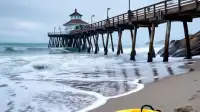
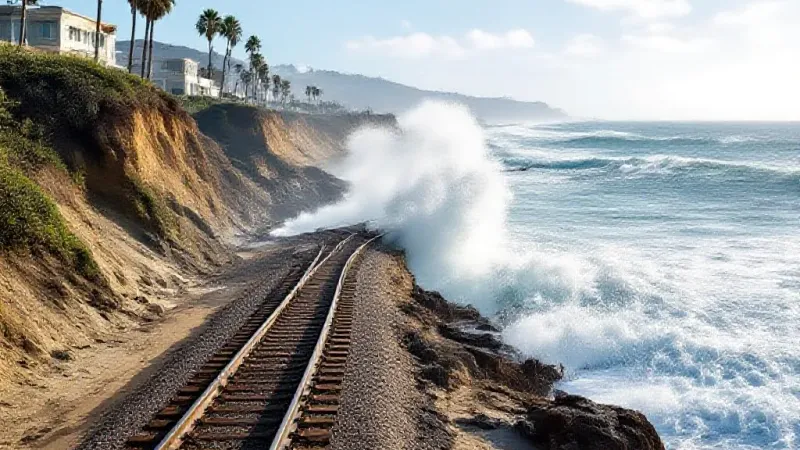
A critical portion of the Metrolink Pacific Surfliner rail line in San Clemente is undergoing emergency repairs and is expected to remain closed until Friday, according to an Orange County Transportation Authority (OCTA) update issued on Monday. The closure, which began on Sunday, September 6, impacts rail service between the Laguna Niguel/Mission Viejo station and the Oceanside stop in San Diego County, directly affecting commuters and travelers along the South Orange County coast. The disruption follows a period of high tides and rainfall from the outskirts of Hurricane Marie, which battered the coast, particularly in San Clemente, though the storm itself did not make landfall. This marks another instance of the rail line facing shutdowns in recent years due to persistent coastal erosion.
Metrolink confirmed in a news release that tracks between Laguna Niguel/Mission Viejo and Oceanside would be closed on Sunday, September 6, due to “high tides and conditions along the coastal rail corridor.” As a result, OC Line services will only reach the Laguna Niguel/Mission Viejo station, with all services south of this stop suspended. This includes the Pacific Surfliner between Irvine and Oceanside. Amtrak officials have arranged for buses to transport affected passengers between Irvine and Oceanside to mitigate the service interruption.
To stabilize the affected section of the line, the Orange County Transportation Authority and Metrolink announced via an Instagram post on Sunday morning that they are working to add large boulders, commonly known as riprap, to the area. This approach aims to reinforce the tracks against the encroaching ocean.
The affected portion of track is well-acquainted with stabilization efforts. For years, OCTA and San Clemente city officials have been engaged in discussions regarding options for securing the rail line, which runs precariously close to the disappearing coast. In some areas, the track is merely 200 feet from the water, prompting significant concerns about potential track collapse as high tides and surges inch closer. OCTA's repeated solution of adding large boulders to stabilize the area, however, has been met with contention. The use of riprap is known to accelerate sand erosion, a point of concern for San Clemente city officials who fear the further erosion of local beaches.
San Clemente has been grappling with how to preserve its shrinking coastline for an extended period, with both city officials and residents actively seeking solutions to save the city's vulnerable beachfront. Currently, city officials are making progress on securing necessary funding and permits to restore lost land along the coast. Concurrently, local residents have rallied to introduce a 1% sales tax, successfully placing it on the 2026 ballot after gathering over 7,000 signatures from registered voters. This proposed tax is projected to generate approximately $15 million in revenue, earmarked to assist in funding sand placement, various beach projects, and wildfire prevention initiatives within the city.
Despite several options being presented to the city for bringing in sand and replenishing the coast, progress toward these goals has been stalled due to a scarcity of available funding. The ongoing need for emergency repairs to vital infrastructure like the rail line underscores the urgency of addressing the broader issue of coastal erosion and securing long-term financial solutions.