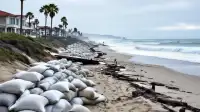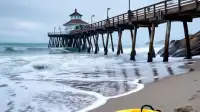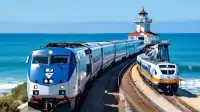
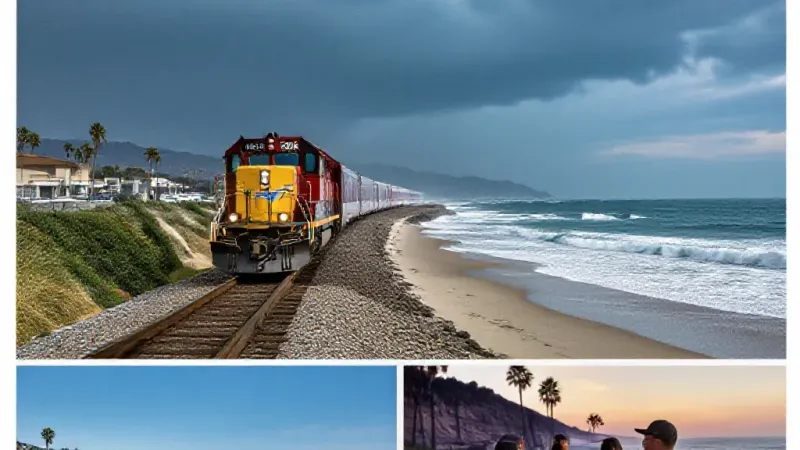
The Orange County Transportation Authority (OCTA) has approved an emergency declaration to place sand and boulders along the San Clemente coastline, aiming to stabilize the Pacific Surfliner rail line. This action comes after a section of the line was closed for over a week due to damage from high tides associated with the outskirts of Hurricane Marie. Despite the urgent approval, leaders are unable to provide a firm timeline for when the sand will actually be added, citing challenges in securing specialized machinery.
The emergency declaration, approved by board members on Monday, allows OCTA to bypass the standard contractor bidding process to expedite the placement of materials. This is a direct response to warnings from the National Weather Service, which indicates a 75% chance of a historic El Niño event this season, potentially bringing heavy rainfall and high tides to Southern California.
Under the emergency plan, a total of 690,000 cubic yards of sand is slated for placement along the rail line in San Clemente. Specifically, 240,000 cubic yards will be added between North Beach and Mariposa Point, with an additional 450,000 cubic yards designated for San Clemente State Beach, according to a report from the agency. This substantial amount of sand is expected to create 80 to 130 feet of new dry beach in these areas, providing a buffer for the rail lines.
In addition to sand, the emergency declaration will also accelerate the placement of riprap, large rocks and boulders used to stabilize the rail line. While the OCTA website estimates that 95% of the material placed will be sand and 5% will be riprap, the use of riprap has been noted to accelerate erosion, contributing to San Clemente's persistent issue with coastal erosion. The agency's report also mentioned the development of an “engineered shoreline protection structure” in south San Clemente, though finalized plans for its design are not yet available, as stated by OCTA Spokesperson Eric Carpenter.
OCTA Chair Jamey Federico emphasized the urgency of the situation in a press release, noting that the emergency action empowers OCTA to move swiftly to bolster rail line protection and maintain safe train operations, especially with potential El Niño conditions approaching. However, the timeline for the actual delivery of sand remains uncertain. OCTA Spokesperson Eric Carpenter stated in an email on Tuesday that there is no firm completion date for all emergency work, explaining that few U.S.-qualified hopper dredges capable of performing this task are available, as many are already committed to other projects months in advance.
The coastal rail line in San Clemente has a history of closures during periods of high tide, with waves frequently overtopping the tracks. City leaders in San Clemente have highlighted the severity of the long-standing coastal erosion issue, estimating a need for over four million cubic yards of sand in the coming years to preserve the beaches. Efforts to secure funding and solutions have included residents rallying to support Measure M, a 1% sales tax appearing on the ballot this year, aimed at coastal preservation.
San Clemente City Manager Andy Hall, speaking at the Monday board meeting, expressed optimism about collaboration between the city and OCTA. Hall noted that the city's coastal preservation efforts align closely with OCTA's goals, anticipating that the partnership will not only safeguard the rail but also improve other critical issues in San Clemente. In an email on Tuesday, Hall reiterated the city's positive outlook regarding OCTA's commitment to include beach nourishment in its stabilization efforts, expecting a more resilient shoreline. However, he also underscored that, like all infrastructure, the beach will require ongoing maintenance to prevent facing similar challenges in the future.