
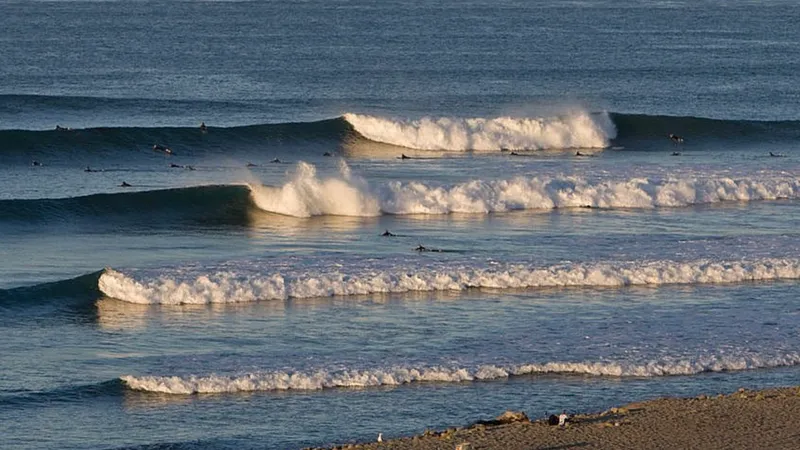
Lower Trestles, often simply called Lowers, stands as a cornerstone of the surfing world, a distinguished cobblestone point break located within the broader Trestles complex on the San Clemente coastline. It is widely acknowledged as the premier break among its neighbors, which stretch from Cottons and Barbed Wires in the north, through Uppers and InBetweens, down to Middles and Church in the south. This particular stretch of ocean matters immensely to the local community and the global surfing scene alike, not only for its consistent, high-quality waves but also for its elevated status as a competitive venue. Its reputation for world-class conditions has attracted the highest levels of professional surfing, culminating in its selection as the host for the surfing competition at the 2028 Summer Olympics, a momentous announcement that cements its place in athletic history.
The history of Lower Trestles as a site for elite competition is relatively recent but impactful. From 2021 through 2024, it served as the critical venue for the World Surf League (WSL) Finals, a one-day title decider that crowned the sport's annual champions. This period saw some of surfing's most iconic figures tested by Lowers' waves. Gabriel Medina and Carissa Moore claimed the inaugural titles in 2021, followed by Filipe Toledo and Stephanie Gilmore in 2022. Toledo returned to victory alongside Caroline Marks in 2023, while John John Florence and Caitlin Simmers emerged victorious in 2024. These events brought international attention and top-tier athletic performance directly to San Clemente's shores, showcasing the break's demanding yet rewarding nature. The decision to host the 2028 Summer Olympics here further elevates its historical significance, marking it as a globally recognized stage for athletic excellence and a point of local pride.
Today, Lower Trestles remains a vibrant and dynamic natural environment, managed as part of San Onofre State Beach by State Parks. It is, at its core, a natural cobblestone point break, where the unique geological formation creates long, peeling waves ideal for progressive surfing maneuvers. The primary activity there continues to be surfing, attracting a dedicated community of local and visiting surfers who are drawn to its consistent and powerful swell. The wave’s character, described by surfers as a point break that "keeps going," allows for extended rides and multiple maneuvers, making it a favorite for both high-performance surfing and pure enjoyment. However, the experience of being at Lowers is shaped by its popularity and accessibility; while a pristine natural setting, it is rarely solitary.
The use of Lower Trestles today is intrinsically linked to its reputation. It is consistently crowded, a testament to its exceptional quality, with this intensity often peaking during prime south swells. Fall is frequently cited by Surfer and Surfertoday sources as the optimal season, when conditions align most favorably. Surfers seeking to experience Lowers should anticipate these crowds and understand the etiquette common to highly competitive surf spots. The management by State Parks dictates certain operational hours for the broader San Onofre State Beach area, from early morning until late evening, and specific rules are in place, such as the prohibition of dogs on the beach, to preserve the natural environment and ensure safety for all users.
For anyone planning a visit to Lower Trestles, several practical considerations are important to ensure a smooth and enjoyable experience. Crucially, there is no direct vehicle access to the beach. Visitors must park at the Cristianitos/El Camino Real parking area and undertake a walk or bike ride of roughly 20 to 30 minutes down a dedicated trail. Parking at the lot is paid, and on particularly busy days, when the lot fills, street parking may be found on Cristianitos. Given the distance, carrying a surfboard and other gear can be physically demanding, requiring preparedness for the trek. Restroom facilities in the area are limited, which is a key detail for planning a longer stay. Surf conditions, as reported by Surfer and Surfertoday sources, are best experienced on a south or southwest swell, coupled with light east winds, with ideal wave heights typically ranging around 4 to 6 feet. Finally, due to the high demand for its waves, visitors are often reminded to respect the established "localism" at peak times. This aspect of surf culture, while sometimes challenging for newcomers, is a natural outgrowth of a cherished, world-class break and contributes to the unique social dynamics of the lineup. Understanding and respecting these unwritten rules can contribute significantly to a positive experience at one of San Clemente's most treasured natural assets.