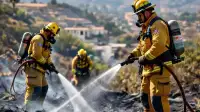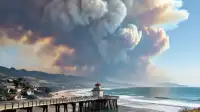
San Clemente residents are confronting a dual challenge, managing the aftermath of a significant wildfire that swept through local foothills as the city simultaneously braces for a severe El Niño winter predicted to intensify coastal erosion and threaten vital infrastructure. Last week, a wildfire broke out in San Clemente's bushy foothills, burning rapidly towards hillside neighborhoods and destroying at least six homes in nearby San Juan Capistrano. The blaze, named the Norte fire, consumed 570 acres and was fanned by strong Santa Ana winds.
By Monday, firefighters were actively working to wash pink fire retardant off streets and finalize containment lines around the charred hills between San Clemente and San Juan Capistrano. The smell of smoke lingered in the air, and crows circled the blackened earth. Resident Rebecca Schwarz, surveying the damage with her partner Todd and their border collie Bodie, lamented, “We lost our beaches and our trails within two weeks.” Todd Schwarz observed that while it was windy on Friday morning, mountain bikers and runners were still using the trails around Patriots Hill. Days before the fire, remnants of Tropical Storm Rachel had delivered rain to the coastline, but not enough to significantly moisten the bone-dry vegetation, according to the source material.
With the fire now under control, a new concern has emerged for affected areas: mudslides. Roots that typically stabilize the soil have burned away, and the intense heat seared the dirt, diminishing its capacity to absorb water. Resident Suj Naran expressed concern about mudslides, asking if that was now the next worry with El Niño approaching. Some houses in the neighborhood already had piles of sandbags on their front porches in anticipation.
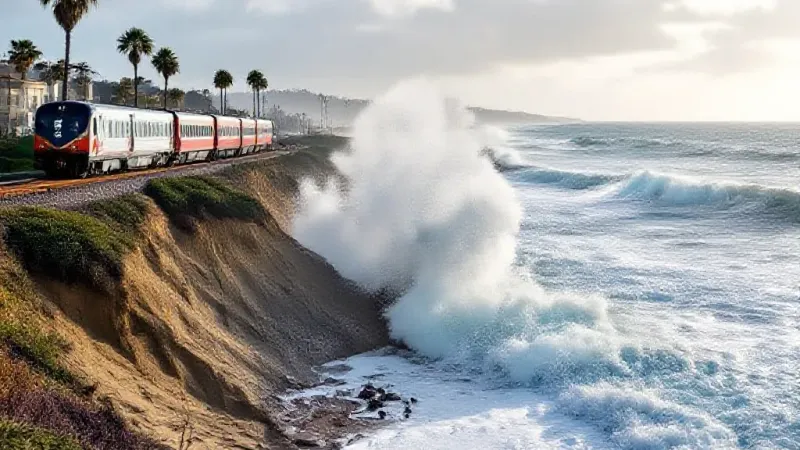
Beyond the immediate fire threat, the city has for months been contending with widespread coastal erosion driven by El Niño-related Pacific storms. This erosion has significantly reshaped San Clemente's beaches and threatened the crucial rail line that serves commuters via the Pacific Surfliner and Metrolink, as well as freight operations. The National Oceanic and Atmospheric Administration's Climate Prediction Center indicates there is virtually a 100% chance this El Niño season will be categorized as "very strong," with an 83% chance it could be the strongest on record since 1950. Forecasters are predicting further coastal flooding and erosion this winter.
The busy rail corridor along San Clemente's 4.7 miles of shoreline has repeatedly faced problems due to erosion and slope damage. In January 2024, a landslide above the railroad at Mariposa Point sent soil and debris onto the tracks, destroying the city’s pedestrian bridge and beach trail and temporarily halting rail service. The Orange County Transportation Authority (OCTA) and Metrolink responded by constructing a 200-foot-long wall to restore service and are moving forward with a project to enhance protection at Mariposa Point. Additionally, high tides over the summer resulted in train cancellations and emergency repairs to the rail line. The OCTA is expected to finalize a study in the coming weeks evaluating strategies to protect the seven miles of railroad through Dana Point and San Clemente for the next 30 years.
The impact of coastal erosion is particularly visible at the beach. Without natural sand replenishment, high tides and large surf have led to entire beaches being covered by water, cutting off public access. In 2024, the city undertook a beach replenishment effort, adding approximately 200,000 cubic yards of sand near the pier and 37,000 cubic yards at North Beach. While this project successfully widened the beach and protected infrastructure, including the city's marine safety headquarters, it represents only a fraction of what will be needed long-term, according to the city’s coastal strategic plan. Coastal engineers estimate that millions of cubic yards of sand will be required to fully replenish the coastline.
Funding for such extensive projects remains a significant challenge for San Clemente. Mayor Rick Loeffler pointed out San Clemente’s lack of significant revenue-generating entities like car dealerships, Costcos, or large hotels. The 2024 multimillion-dollar replenishment project was funded through a joint effort involving federal, state, and city contributions, with the state covering a portion of San Clemente’s costs.
To address these ongoing needs, residents will vote next month on a ballot measure proposing a 1% sales tax increase for 10 years. This measure aims to fund sand replenishment projects, beach erosion control, and fire protection services. A similar ballot measure in 2024, which focused solely on sand replenishment and not fire prevention, failed to achieve the necessary two-thirds majority for passage. Mayor Loeffler linked the timeliness of the ballot measure to the recent fire, remarking, “It’s kind of timely with this fire that just happened.” He further suggested the fire situation could be more severe than sand replenishment if a large canyon fire occurred.
Much of San Clemente’s hillside communities, specifically those past the 5 Freeway, are classified as high or very high fire hazard zones by the California Department of Forestry and Fire Protection. The city has already taken steps like deploying goats to clear invasive brush along hillsides. Planning Commissioner Cameron Cosgrove, a 14-year San Clemente resident and the author of the new ballot Measure M, stated, “We’re in a crisis,” noting high wildfire risk and eroding beaches. Measure M is designed to provide funds for staging air assets and firefighters during high-wind events to quickly suppress potential fires, remove highly flammable nonnative vegetation from about 5,000 acres of open space, and replace them with native plants.